SEO Keyword Planning for Small Businesses: Turn Customer Questions Into a Content Plan
A step-by-step approach to finding the questions your customers search for, prioritizing them and turning them into a publishing plan that builds visibility over time.
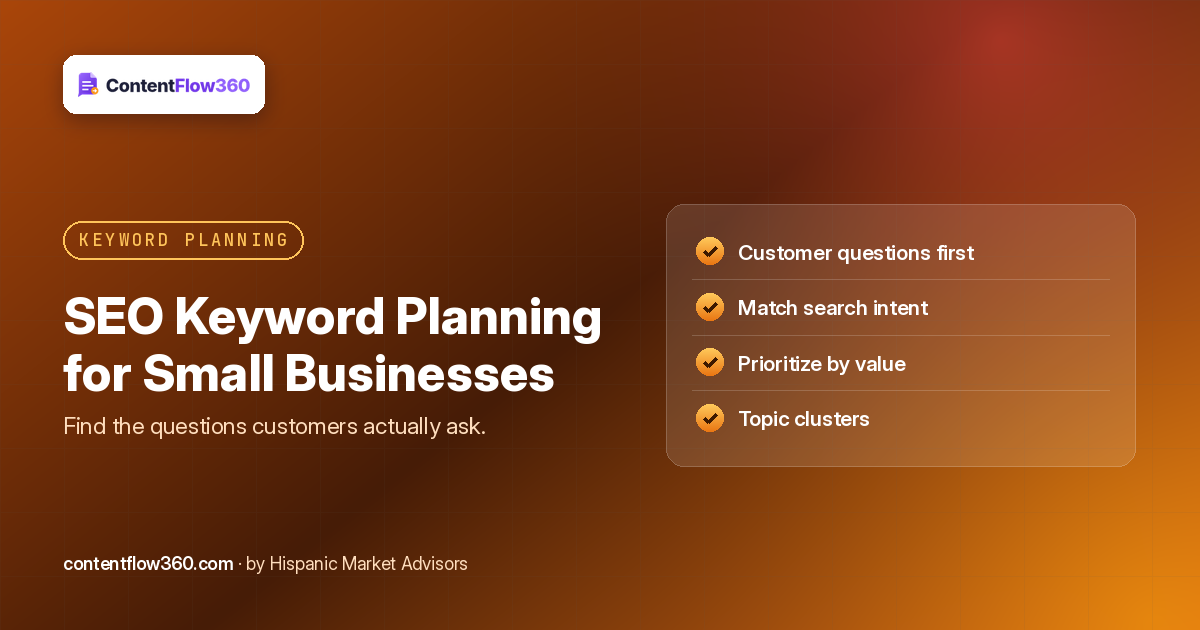
Keyword research sounds technical, but at its heart it is simple: figure out what your customers type when they are looking for what you offer, then publish the best answer. The challenge for most small businesses is not understanding the idea. It is finding the time to do it well and turning research into an actual plan.
This guide walks through a practical keyword planning process you can use whether you do it by hand or with an agentic tool.
Start with your customers, not a tool
Before looking at any data, write down the questions customers ask you. Think about phone calls, emails, chats and conversations in person. Ask your team, too. You will often end up with dozens of questions such as:
- How much does this usually cost?
- How long does it take?
- What should I look for when choosing a provider?
- What is the difference between option A and option B?
- Do I need this, or can I do it myself?
These questions are gold. They reflect real search behavior and real buying intent, and they are often less competitive than broad industry keywords.
Understand search intent
Every search has a purpose. Broadly, intent falls into four groups:
- Informational: the person wants to learn something.
- Comparison: they are weighing options.
- Transactional: they are ready to act or buy.
- Local: they want a provider near them.
A strong content plan covers all four. Informational articles build trust early. Comparison content helps people decide. Local and transactional pages convert. If you only publish one type, you miss customers at other stages.
Expand and validate your list
Once you have your seed questions, expand them. Look at related searches, common variations and the way people phrase things in everyday language. If you serve a bilingual market, research Spanish phrasing separately; people do not always search for the direct translation of an English term.
An agentic tool like ContentFlow360 can do much of this work for you, discovering the questions and keywords your customers search for and turning them into a prioritized topic plan.
Prioritize what to write first
You will end up with more ideas than you can publish. Prioritize using three questions:
- Business value: how closely is this topic tied to a service you want to sell?
- Effort to rank: are the current results dominated by huge websites, or is there room for a helpful local answer?
- Expertise: can you say something genuinely useful based on experience?
Topics that score well on all three go to the top of the list.
Organize topics into clusters
Search engines and AI assistants reward websites that cover a subject thoroughly. Instead of scattered one-off posts, group related topics into clusters. One comprehensive guide covers the main topic, and several supporting articles go deeper into specific questions, each linking back to the guide.
Clusters make your site easier to navigate, help readers find related answers and show that you are an authority on the subject.
Turn the plan into a calendar
A keyword list does nothing until it becomes a publishing schedule. Decide on a realistic frequency, perhaps two to four articles a month, and map your prioritized topics to dates. Account for seasonality; publish seasonal topics several weeks before demand peaks so they have time to be discovered.
ContentFlow360 places every upcoming article on one content calendar so you can keep a steady rhythm without scrambling.
Write briefs before drafts
Every article should start with a brief: the target keyword, the search intent, an outline, the key points about your business to include and the question the article must answer in its opening paragraphs. Briefs keep articles focused and make reviews faster, because everyone agrees on the goal before a word is written.
Optimize for AI-powered search too
More people now ask AI assistants for answers and recommendations. Content that performs well there tends to:
- State a clear answer near the top.
- Use descriptive headings that mirror real questions.
- Include specific, accurate details rather than vague claims.
- Come from a site that consistently covers a topic in depth.
The good news is that these are the same habits that help in traditional search. A solid keyword plan serves both.
Why this was hard under the old model
Traditional agencies treated keyword research as a separate, billable project, often delivered as a spreadsheet that sat unused. The research and the writing were done by different people at different times, so plans drifted. An agentic workflow connects research, briefs, drafting and publishing in one continuous process, so the plan actually gets executed.
Your next step
Start by writing down twenty customer questions this week. Group them by intent, pick the five with the highest business value and schedule them. When you are ready to make the process effortless, ContentFlow360 builds the keyword plan, drafts the articles in English and Spanish and publishes them on schedule after your approval.
Join the waitlist to get early access as part of the GrowthFlow360 Business Suite.